

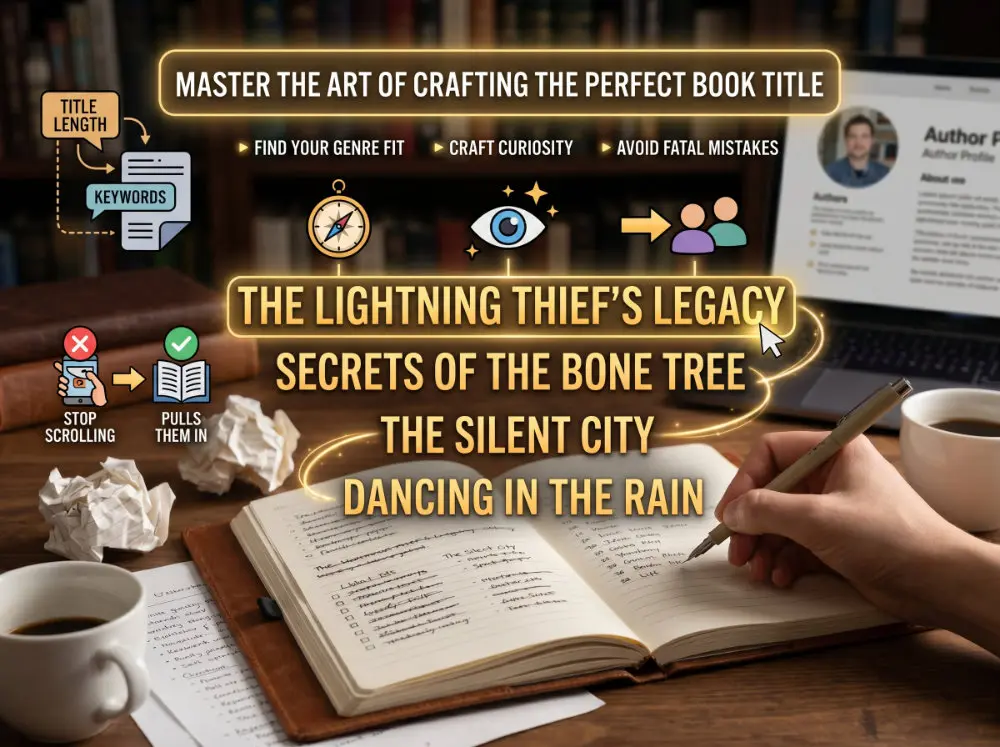
Summary: Your book title is your first, and sometimes only, chance to get a reader to stop scrolling. This guide breaks down what makes a great title, how to brainstorm one that fits your genre, and the specific mistakes that kill a title before it even gets a chance.
Your book title is doing more work than anything else you’ll write. And it’s probably the thing you spent the least time on.
I’ve helped authors build websites across every genre. And here’s the thing: when I ask an author about their book, the title is always the first thing they say. It’s on their covers, their website headers, their social profiles, their email signatures. It’s the single most repeated piece of text in their entire author brand. Yet most indie authors pick a title the same way they pick a WiFi password. Fast, stressed, and without much thought.
Let me be straight with you: a bad title doesn’t just sit there quietly. It actively pushes readers away. A good title pulls them in, sets the right expectations, and makes the cover art click. That’s the difference between a scroll-past and a click.
This guide is everything I know about what makes a book title work, and the specific traps I see authors fall into over and over.
📖 Why Your Book Title Matters More Than You Think
Here’s something I tell every author I work with: your title and your cover are a team. They have about two seconds to communicate three things: genre, tone, and “is this for me?”
Think about it from the reader’s perspective. They’re scrolling through Amazon, or browsing a bookstore shelf, or scanning a list of recommendations. Your title is competing with hundreds of others in the same glance. It needs to:
- Signal the genre instantly — a romance reader and a thriller reader are looking for very different words
- Create curiosity — enough to make someone tap, click, or pick it up
- Be memorable — so they can tell a friend about it later
- Fit the cover — because title and cover work together or they don’t work at all
Skip any one of these and you’re fighting uphill.
🔍 Fiction vs. Nonfiction: Two Completely Different Games
Let’s split this up because fiction and nonfiction titles follow totally different rules. Treating them the same is one of the fastest ways to get it wrong.
Fiction: Atmosphere First
Fiction titles sell a feeling. They promise an emotional experience before the reader has read a single page.
| What Works | Why | Example |
|---|---|---|
| Character names | Creates immediate intimacy | The Great Gatsby, Eleanor Oliphant Is Completely Fine |
| Place or setting | Anchors the story in a world | The House on Mango Street, Wuthering Heights |
| Symbolic phrases | Hints at the deeper theme | To Kill a Mockingbird, The Kite Runner |
| Genre-coded language | Tells the reader “this is for you” | A Court of Thorns and Roses, The Girl on the Train |
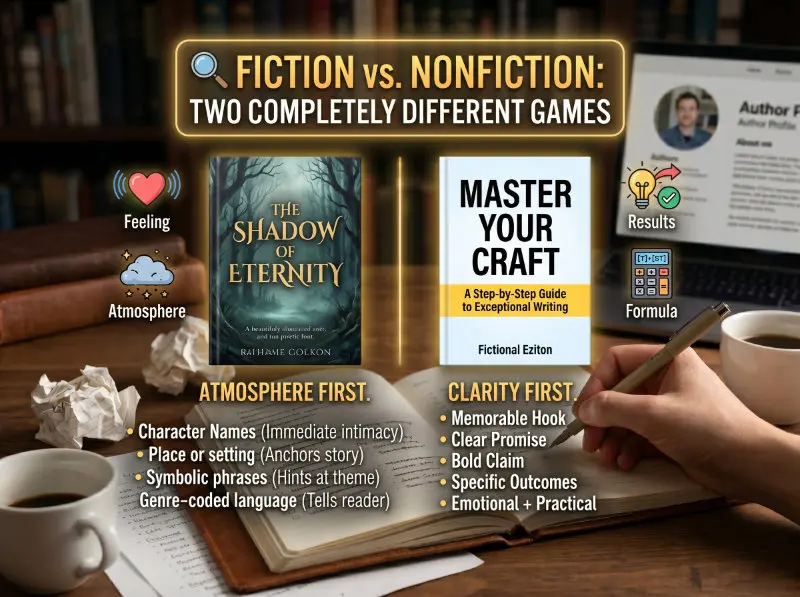
The key with fiction is that the title should feel like the book. A cozy mystery should feel warm and a little playful. A dark thriller should feel tense. A literary novel might be more poetic.
The test: Read the title out loud. Does it sound like it belongs on the cover you’re imagining? If the title says “cozy afternoon” but the cover says “someone’s about to die,” one of them is lying.
Nonfiction: Clarity First
Nonfiction titles sell a result. The reader wants to know exactly what they’ll learn or gain.
The formula that works best:
Catchy Title + Descriptive Subtitle
| Title | Subtitle | Why It Works |
|---|---|---|
| Atomic Habits | An Easy & Proven Way to Build Good Habits & Break Bad Ones | Title = memorable hook, Subtitle = clear promise |
| The 4-Hour Workweek | Escape 9-5, Live Anywhere, and Join the New Rich | Title = bold claim, Subtitle = specific outcomes |
| You Are a Badass | How to Stop Doubting Your Greatness and Start Living an Awesome Life | Title = emotional, Subtitle = practical |
For nonfiction, the subtitle does the heavy lifting. It’s where you put the keywords, the specific promise, and the reason someone should buy this book instead of the twelve others on the same topic.
🎯 The 5-Point Title Checklist
Before you commit to any title, run it through these five filters:
1. Is It Genre-Appropriate?
Go to Amazon. Pull up the top 20 bestsellers in your specific category. What patterns do you see in their titles?
- Romance titles tend to be shorter, emotionally charged, sometimes playful
- Thrillers use stark, punchy words like “gone,” “girl,” “silent,” “dark”
- Fantasy goes bigger, with longer titles and more world-building in the words
- Self-help uses “you” language and action verbs
Your title doesn’t need to copy these patterns, but it should feel like it belongs in the same neighborhood.
2. Can Someone Spell It Over the Phone?
This sounds silly. It’s not. If a reader loves your book and wants to tell a friend about it, they’ll say the title out loud. If it’s hard to spell, hard to pronounce, or easy to confuse with another book, you’ve just made word-of-mouth harder for no reason.
3. Is It Already Taken?
You can’t copyright a book title. That’s true. But using the same title as a recent, well-known book in your genre is asking for trouble. Your book will compete with theirs in every search result, and they’ll probably win.
Do a quick Amazon search, a Google search, and check Goodreads. If your title is already attached to a popular book in the same genre, pick something else.
4. Does It Work as a Thumbnail?
Most readers will first see your cover as a tiny thumbnail on a screen. Your title needs to be readable at that size. This means:
- Shorter is usually better (3-5 words is the sweet spot for fiction)
- Avoid long, complicated words that get squished on a cover
- Make sure the title font is legible, even at 100 pixels wide
5. Does It Pass the “Tell Me More” Test?
Say your title to five people who haven’t read your book. Ask them: “What do you think this book is about?” If they guess correctly, or close enough, you’ve nailed it. If they look confused or guess the wrong genre entirely, back to the drawing board.
💡 How to Brainstorm Titles (Without Staring at a Blank Page)
Here’s the process I recommend:
Step 1: Start With a Working Title
Don’t try to nail it on draft one. Give your book a placeholder name and keep writing. Some of the best titles in publishing history were decided at the very end. To Kill a Mockingbird was almost called Atticus. The title will come once you understand the full shape of your story.
Step 2: Word Dump Everything
Open a blank doc and list every word that connects to your book:
- Themes (betrayal, second chances, survival, identity)
- Settings (the lake house, Brooklyn, the starship)
- Character traits (defiant, quiet, broken, brilliant)
- Mood words (dark, whimsical, gritty, lush)
- Key objects or symbols (the red door, the letter, the lighthouse)
Don’t filter. Just dump. You want 50+ words.
Step 3: Combine and Play
Start mashing words together. Try:
- [Adjective] + [Noun]: The Silent Patient
- The [Noun] of [Noun]: The Name of the Wind
- [Character] + [Action]: Eleanor Oliphant Is Completely Fine
- [Number] + [Promise]: The 7 Habits of Highly Effective People
- [Question]: Where the Crawdads Sing
Step 4: Use Tools (But Don’t Let Them Decide for You)
Title generators can be useful for sparking ideas you wouldn’t have thought of on your own. We’ve got a free AI Book Title Generator that’s built specifically for indie authors. You tell it your genre, theme, and tone, and it gives you options to riff on. It’s not going to give you the perfect title, but it might give you the word or phrase that unlocks the perfect title.
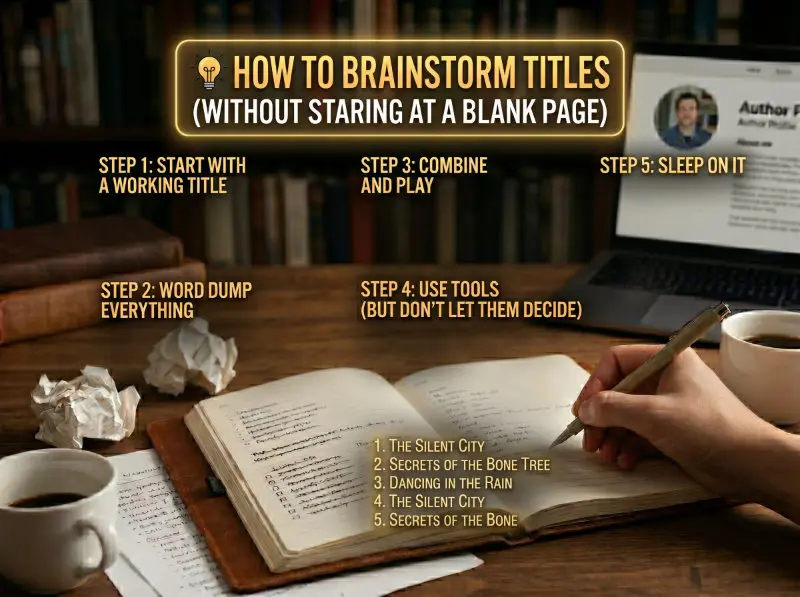
Step 5: Sleep On It
Seriously. Don’t pick your title the same day you brainstorm it. Write your top 5 on a sticky note, put it where you’ll see it for a few days, and notice which one your eyes keep landing on. That’s usually the one.
❌ The 7 Title Mistakes I See Constantly
Mistake #1: Being Too Vague
Whispers. That could be a romance, a thriller, a horror novel, or a poetry collection. If your title could belong to any genre, it’s not working hard enough.
Mistake #2: Being Too Clever
Wordplay and puns can work, but only if the reader gets the joke before they read the book. If the cleverness only makes sense after Chapter 12, it’s not helping you sell copies.
Mistake #3: Copying a Trend Too Late
If “Girl” titles were hot three years ago (Gone Girl, Girl on the Train, The Girl with the Dragon Tattoo), don’t publish The Girl Who [Something] today. You’ll look like you’re chasing, not leading.
Mistake #4: Making It Too Long
Fiction titles over 6-7 words start getting hard to remember and hard to fit on a cover. There are exceptions, but you need to earn them with a title that’s genuinely compelling at that length.
Mistake #5: Ignoring Subtitle Potential (Nonfiction)
Your nonfiction title is catchy but tells the reader nothing about what’s inside. Without a subtitle, you’re relying entirely on the cover art to communicate the book’s value. That’s a lot of pressure on one image.
Mistake #6: Not Checking How It Sounds Out Loud
Some titles look great on paper but sound awkward when spoken. “The Thorns of Thornfield.” Try saying that three times fast. If it’s going to come up in podcast interviews, book club discussions, or conversations with friends, it needs to flow.
Mistake #7: Choosing the Title You Like Instead of the Title That Works
This is the hardest one. Your favorite title might not be the best title for selling your book. The title isn’t for you. It’s for the reader who hasn’t met you yet.
🔧 Testing Your Title Before You Commit
Before you finalize, do these three things:
1. Amazon Search Test
Type your title into Amazon’s search bar. What comes up? If the first page is dominated by a mega-bestseller with the same or similar title, reconsider.
2. The Five-Person Test
Ask five people in your target audience: “What genre do you think this is? What do you think it’s about?” If they can’t answer or they guess wrong, your title isn’t communicating clearly.
3. The Cover Mock-Up Test
Put your title on a basic cover mock-up (even just text on a colored background). Shrink it down to thumbnail size. Can you still read it? Does it look like it belongs in your genre’s category? This is how most readers will first encounter your book.
✅ Here’s What We Covered
- Your title is doing more work than any other piece of text in your author brand. Give it the time it deserves.
- Fiction titles sell feeling and atmosphere. Nonfiction titles sell clarity and results.
- Run every title through the 5-Point Checklist: genre-appropriate, spellable, unique, thumbnail-readable, and passes the “tell me more” test
- Use the brainstorm process: working title → word dump → combine → tools → sleep on it
- Avoid the 7 common mistakes, especially picking the title YOU like over the title that WORKS
- Test before committing: Amazon search, five-person test, cover mock-up
❓ Frequently Asked Questions
How many words should a book title be?
For fiction, 1-5 words is the sweet spot, though there are plenty of successful titles that go longer. For nonfiction, the title itself should be short and punchy (2-5 words), with a longer subtitle doing the descriptive work. The real test isn’t word count. It’s whether the title is memorable and readable on a thumbnail.
Can two books have the same title?
Legally, yes. You can’t copyright a book title. But practically? Avoid it if the other book is well-known, especially in your genre. You’ll be fighting for search visibility and confusing readers. A unique title gives you a much cleaner path to discoverability.
Should I use a subtitle for my fiction book?
Usually not. Subtitles work great for nonfiction because readers expect clarity about what they’ll learn. For fiction, a subtitle can feel clunky or over-explanatory. Exceptions exist (series labels like “A Throne of Glass Novel” work), but the title itself should stand alone.
When should I finalize my book title?
There’s no rule, but most experienced authors finalize their title after the first draft is complete. Sometimes not until the manuscript is nearly final. Your title should reflect the finished book, not the idea you started with. That said, having a working title from day one helps you talk about and think about the project.
Can AI help me come up with a book title?
Absolutely, as a brainstorming tool. An AI title generator can give you combinations and angles you wouldn’t think of on your own. We built a free AI Book Title Generator for exactly this purpose. But treat the output as raw material, not the final answer. The best title will come from you refining and filtering those ideas through your knowledge of your story and your readers.
Written by Hayward Rodgers, founder of My Indie Author Site, where indie authors get the professional websites their books deserve.