

TL;DR: Grow your author email list by installing a free WordPress email plugin like Mail Mint, creating a reader magnet worth signing up for, placing signup forms in 5 key spots on your site, and setting up a 3-email welcome sequence. No budget required.
Your author email list is the one marketing channel you actually own. Social platforms change their algorithms, bookstores shuffle their shelves, and ads get more expensive every year. But your email list? That’s yours. Every subscriber chose to hear from you, and nobody can take that away. Here’s how to start building one from scratch using free tools that live right inside your WordPress author website.
🤔 Why Your Email List Matters More Than Your Social Following
Here’s a question that trips up a lot of indie authors: “Should I focus on growing my Instagram or my email list?”
It’s not even close. Email wins every time.
Now, that doesn’t mean social media is useless. It’s not. Social media is great for brand awareness, building community, and getting your name in front of people who’ve never heard of you. It’s how a lot of readers will discover you in the first place. But discovery is step one. The goal is to move those people from your social feed to your website, and from your website to your email list. That’s where the real relationship starts.
Here’s why: social media is rented land. You’re building an audience on someone else’s platform, playing by their rules. One algorithm tweak and your reach drops overnight. We’ve all seen it happen. Facebook pages that used to get thousands of views now reach a handful of followers organically.
Your email list is different. When someone gives you their email address, they’re saying, “Yes, I want to hear from you.” That’s powerful. And unlike a social media follow, an email lands directly in their inbox. No algorithm standing between you and your reader.
The numbers back this up. Email marketing consistently delivers higher engagement than social media for authors. Your newsletter subscribers are the people most likely to pre-order your next book, leave a review on launch day, and tell their friends about you.
Think of it this way: social media fills the top of your funnel. Your email list is where you turn followers into fans. You need both, but if you had to pick one to invest in today, the email list wins every time.
If you haven’t started your email marketing for authors strategy yet, this is your sign. Let’s build it.
📧 Step 1: Choose Your Email Platform (WordPress-Native)
Most email marketing guides will tell you to sign up for Mailchimp or ConvertKit. Those are fine tools, but if you already have a WordPress author website, you’ve got a better option sitting right inside your dashboard.
Mail Mint is a WordPress plugin that handles your email list, signup forms, and automated sequences, all from inside WordPress. No separate login. No third-party platform. No monthly fees eating into your book royalties.
Why WordPress-native email matters:
| Feature | External Platform (Mailchimp, etc.) | WordPress-Native (Mail Mint) |
|---|---|---|
| Cost | Free tier, then $13–$50+/mo | Free (plugin) |
| Where it lives | Separate website/login | Inside your WordPress dashboard |
| Form integration | Embed codes, plugins needed | Built-in, drag-and-drop |
| Data ownership | They hold your list | You own everything |
| Automation | Yes (paid tiers) | Yes (included) |
You don’t need to pay $20/month to send a newsletter to 500 subscribers. Not when you’re just getting started. Mail Mint lets you grow your list for free and upgrade only when your audience (and your income) justifies it.
How to set it up: Install the Mail Mint plugin from your WordPress dashboard → Plugins → Add New. Activate it, and you’ll see it in your sidebar. That’s it. You now have a fully functional email marketing platform inside your website.
🎁 Step 2: Create a Reader Magnet Worth Signing Up For
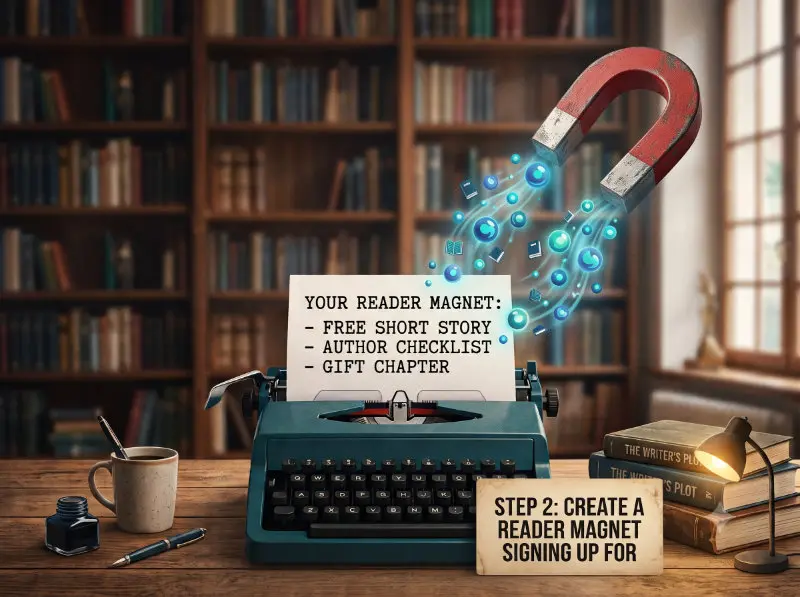
Nobody signs up for “updates.” Sorry, but “Subscribe to my newsletter!” doesn’t work anymore. People get hundreds of emails a day. You need to give them a reason.
That reason is called a reader magnet, a free piece of content so useful or entertaining that someone happily trades their email address for it.
Reader magnet ideas that actually work for authors:
- A free short story or novella set in your book’s world (fiction authors, this is your power move)
- A checklist or cheat sheet related to your nonfiction topic (we just made one: an author website checklist pulled from our pillar guide)
- A sample chapter of your upcoming book
- A quick-reference guide — something readers would bookmark and come back to
- A printable worksheet that helps them apply what you teach
The Reader Magnet Test
Before you create yours, ask: “Would I give my email for this?” If the answer is “meh,” go back to the drawing board. Your reader magnet should feel like a gift, not a trade.
Keep it short. A 3-page checklist beats a 50-page ebook every time. People want quick wins, something they can use today, not a homework assignment.
📍 Step 3: Put Your Signup Where Readers Actually See It
You built a reader magnet. You installed Mail Mint. Now here’s where most authors fumble. They bury their signup form on a page nobody visits.
Your email signup should be everywhere a reader might be ready to say yes. Not in an aggressive, pop-up-every-3-seconds way. In a “hey, here’s something free if you want it” way.
The 5 places every author website needs a signup form:
- Homepage — above the fold, before they scroll. This is your highest-traffic page. If you’re not capturing emails here, you’re leaving readers on the table.
- End of every blog post — someone who just read your entire article is warm. They like what you have to say. That’s the perfect moment to offer your reader magnet.
- Dedicated landing page — a standalone page with one job: get the signup. No navigation menu, no distractions. Just the offer and the form. Link to this from social media bios and guest posts.
- About page — readers who visit your About page are curious about you. They’re already leaning in. Give them a reason to stick around.
- Sidebar or footer — a persistent signup that follows readers across your site. Not the hero placement, but it catches the ones who are browsing around.
If you’re not sure what should be on an author website, start with these five placements. You can always add more later.
Pro move: Create a different reader magnet for different pages. Your blog post about writing dialogue? Offer a dialogue cheat sheet. Your books page? Offer a free first chapter. Matching the magnet to the context is how you get conversion rates that actually feel good.
🚀 Step 4: Drive Traffic to Your Signup (Free Methods)
Your signup forms are live. Your reader magnet is ready. Now you need people to actually see them.
Good news: you don’t need to spend money on ads to grow your author email list. Here are the methods that work, and they’re all free.
Write blog posts that answer real questions
This is the long game, and it’s the most powerful one. When you publish helpful content on your author website, Google sends you readers on autopilot. Those readers find your signup forms, grab your reader magnet, and join your list while you sleep.
Write about what your target readers are searching for. If you write fantasy, that might be “how to find your next fantasy series.” If you write nonfiction about productivity, maybe it’s “simple morning routine for writers.” The key is answering questions your future readers are already asking.
Show up in author communities
Facebook groups for readers and writers. Reddit’s r/selfpublish and genre-specific subreddits. Goodreads groups. These are places where your future subscribers hang out.
Don’t spam your signup link. Instead, be genuinely helpful. Answer questions. Share your experience. When people click through to your profile or website (and they will), your signup forms are waiting.
Do a newsletter swap
Find another author in your genre with a similar-sized list. You mention their reader magnet to your subscribers; they mention yours. Both lists grow. It’s the indie author version of a collaboration, and it works because the audience is already pre-qualified. They like your genre.
Guest post on writing blogs
Write a guest article for a blog that your readers visit. Include a link back to your website (or directly to your reader magnet landing page) in your author bio. One well-placed guest post can bring in subscribers for months.
Pin your reader magnet on social media
Your Instagram bio link, your X/Twitter pinned post, your Facebook page CTA: all of these should point to your reader magnet landing page. Social media posts disappear in the scroll. Your bio link is permanent real estate.
💌 Step 5: Keep Subscribers With a Welcome Sequence

Getting someone on your list is step one. Keeping them there, and keeping them engaged, is where the real magic happens.
When a new subscriber signs up, don’t just dump them onto your list and hope they remember you. Set up a welcome sequence, a short series of automated emails that introduces you, delivers your reader magnet, and starts building a relationship.
A simple 3-email welcome sequence:
Email 1 (immediate): “Here’s your [reader magnet]!” Deliver what you promised. Include a download link. Thank them for subscribing. Keep it short and warm. Sign off with your name. Make it personal.
Email 2 (2 days later): “A little about me + my best stuff” Tell your story in 3–4 sentences. Why do you write? What can they expect from your emails? Link to your best blog post or your most popular book. Give them a reason to stay.
Email 3 (4 days later): “Quick question for you” Ask a simple question: “What’s your biggest struggle with [your topic]?” or “What kind of books are you reading right now?” This does two things: it gets them to reply (which trains their inbox to show your emails) and it gives you valuable insight into what your audience cares about.
You can set this entire sequence up in Mail Mint’s automation builder. Create it once, and every new subscriber gets the same great first impression, automatically.
❌ Common Email List Mistakes Authors Make
Building your list is exciting. But a few common mistakes can slow your growth or burn out subscribers before they ever buy a book.
Mistake #1: Waiting until your book is “ready.” Start building your list now. Even if your book won’t be out for a year. Every subscriber you collect today is someone you can email on launch day. Waiting means starting from zero when it matters most.
Mistake #2: Emailing too rarely. If subscribers only hear from you once every three months, they’ll forget who you are. Aim for at least twice a month. Consistency beats frequency, so pick a schedule you can actually maintain.
Mistake #3: Only emailing when you’re selling something. If every email is “buy my book,” people unsubscribe. Mix in value: writing updates, free content, behind-the-scenes peeks, personal stories. The ratio should feel like 80% value, 20% promotion.
Mistake #4: Not having a clear CTA. Every email should have one thing you want the reader to do. Read a blog post. Reply to a question. Pre-order your book. One CTA, not five.
Mistake #5: Ignoring your signup form design. A form that says “Subscribe” with a plain box converts worse than one that says “Grab Your Free Fantasy Novella” with a cover image. The words and visuals matter.
📋 Here’s What We Covered
- Your email list is the only marketing channel you truly own — social platforms can change the rules anytime
- Use a WordPress-native tool like Mail Mint to keep costs at zero and your data under your control
- Create a reader magnet that’s so useful people happily trade their email for it
- Place signup forms in 5 key spots on your website — homepage, blog posts, landing page, about page, and sidebar
- Drive traffic for free through blog content, author communities, newsletter swaps, and social media bio links
- Set up a 3-email welcome sequence to turn new subscribers into engaged readers
- Avoid the big mistakes — don’t wait, don’t ghost your list, and don’t make every email a sales pitch
❓ FAQ
How many subscribers do I need before my email list is “worth it”?
Even 50 engaged subscribers can make a difference on launch day. A small list of people who actually open your emails beats a huge list of people who ignore them. Start building now. The best time to grow your list was yesterday.
Can I grow my author email list without a website?
You can use standalone tools like Mailchimp landing pages, but you’re leaving a lot on the table. An author website gives you blog content (which brings organic traffic), multiple signup touchpoints, and a professional home base that makes readers take you seriously. The website and the email list work together. They’re not separate strategies.
How often should I email my subscribers?
Start with twice a month. That’s frequent enough to stay top of mind without overwhelming anyone (including yourself). As you get comfortable, you can increase to weekly. The important thing is consistency. Pick a schedule and stick to it.
Building your author email list doesn’t require a marketing degree or a big budget. It takes a WordPress website, a free email tool, and something worth signing up for. Start with one reader magnet, one signup form, and one welcome email, then grow from there.
Need a website that’s built to capture emails and grow your audience from day one? Check out our plans. Every MIAS site comes with Mail Mint pre-installed, so your signup forms work from day one. Automated sequences and segmentation are available as an add-on if you want us to run them for you. 💌